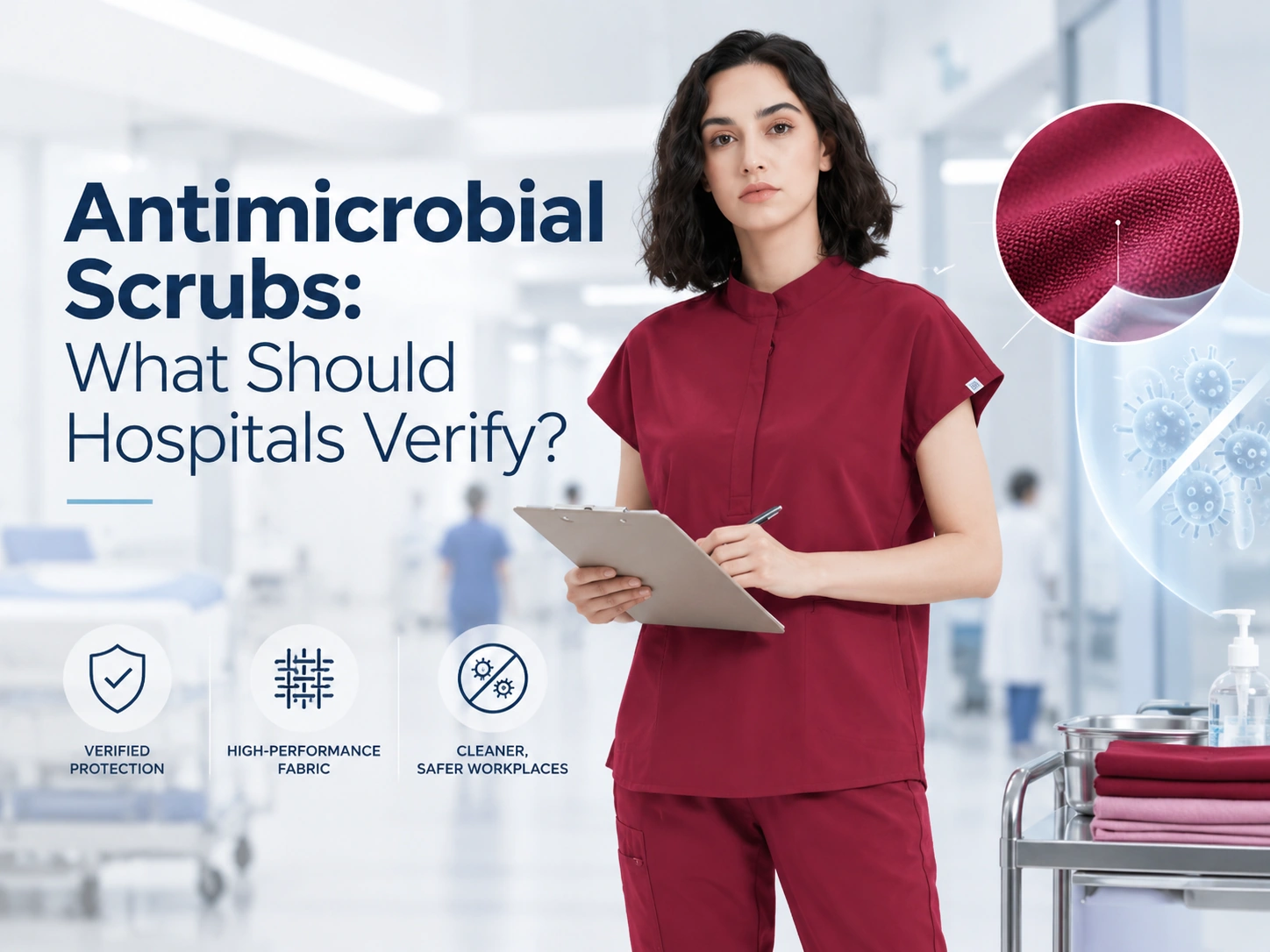
Antimicrobial scrubs can be a useful fabric specification, but the word on a product page is not enough evidence for a hospital uniform program. The buyer needs to know what was tested, on which fabric and finish, against which organism and method, after which care cycle, and whether the same construction will be supplied in bulk. Without those links, a lab result can be true and still not apply to the order.
Fuyi Group‘s medical-uniform documentation describes antibacterial testing and performance scopes for selected medical fabrics, including a documented reference to antibacterial effect after 40 washes at 40°C. That is evidence to verify, not a blanket claim for every scrub style. The purchasing team should treat each antimicrobial scrub claim as a chain of scope decisions.
What an Antimicrobial Scrub Claim Can and Cannot Mean
Surface Performance Is Not a Clinical Outcome
A standard antimicrobial fabric test usually measures what happens to microorganisms on or in the test fabric under specified conditions. It does not prove that wearing the garment prevents infection, reduces transmission in a ward, or replaces hand hygiene, PPE, cleaning, or isolation procedures. A supplier may use the word protection loosely; the buyer should keep the evidence at the level it was tested.
The practical question is not whether the fabric sounds hygienic. It is whether the tested property changes a decision the hospital can defend: whether the finish is part of the garment specification, how it is controlled during production, and what wording the hospital is allowed to use with staff or patients.
Antimicrobial and Antibacterial Are Not Interchangeable Purchasing Terms
The market uses antimicrobial, antibacterial, and bacteriostatic as if they mean the same thing. They do not automatically describe the same target, test method, or performance expectation. A supplier should define the claim in writing and name the organism, test standard or method, specimen, finish, and result being claimed.
If the purchase order says antimicrobial scrubs but the test report covers one fabric swatch under one laboratory method, the two statements are not aligned yet. The buyer should narrow the order to the tested scope or require evidence for the scope actually being bought. The same logic applies when a supplier moves between antibacterial fabric and a broader antimicrobial description in its sales material.
How to Read the Test Record Behind the Claim
Match the Sample, Fabric, and Finish to the Garment Being Ordered

Start with the specimen. A fabric sample, a cut piece from a garment, and a finished garment can produce different results because seams, trims, coatings, and assembly change the surface being tested. Confirm the fibre composition, weight, weave or knit, colour, finish name, and supplier reference. If production fabric comes from another mill or uses a different finish, the old report does not automatically transfer.
The claim may sit on the finished garment even when the test was performed on antimicrobial fabric for scrubs. Sometimes the order is for finished antibacterial scrubs while the report covers only a fabric swatch; the buyer should notice that gap. The test record should also identify the sample stage: development sample, pre-production sample, or production lot. A development-stage result is useful for selection, but it does not prove that the bulk fabric or the finished hospital scrubs fabric was made to the same specification.
Check the Wash Regime and the Point at Which Performance Is Measured
Antimicrobial performance is often reported after laundering because the finish can change with washing. The report should state the wash method, temperature, detergent or chemistry, number of cycles, drying method, and whether the result is measured before or after the stated cycle. A result described as 40 washes at 40°C is not the same specification as a result after five home washes at an unspecified temperature.
Fuyi Group’s medical-uniform documentation uses a 40-wash, 40°C reference for an antibacterial performance scope on selected medical fabric. That gives the buyer a concrete question to ask: does the proposed order use the same fabric and finish, and does the report use the same wash method and test points? If the care instructions differ, the evidence must be checked again.
Confirm the Organism and Test Method, Not Just the Percentage
A headline such as 99% antibacterial is incomplete until the reader knows which organism, which test method, how many replicates, and what result the method defines as passing. Do not compare percentages from different test organisms or methods as if they were the same scale. Ask for the test report and the acceptance criterion used to interpret it.
The report should be linked to the exact claim that will appear on the product page, label, quotation, or purchase specification. If the supplier cannot explain the method in plain language, the buyer cannot verify that the percentage answers the hospital’s question. The correct response is to ask for the missing scope, not to treat the number as universal.
How to Control the Claim in Bulk Production and Reorders
Put the Approved Finish and Sample Into the Production Specification
Once the fabric and finish are accepted, write them into the order specification. Include the mill or supplier reference where relevant, finish name or code, approved colour, test method, wash regime, and the sample that represents the accepted performance. The specification should also state which changes require a new sample or test. Review the current medical scrubs collection before finalising which styles and fabrics can be quoted; the evidence must still cover the exact finish, garment, and production scope.
Production control should distinguish an appearance check from performance evidence. Inspectors can verify colour, construction, labels, and workmanship, but they cannot confirm antimicrobial performance by looking at the garment. The evidence must be tied to the same material scope and the defined test plan.
Define Batch Evidence, Change Control, and Labelling
Ask how the finish is controlled from lot to lot and what evidence will accompany bulk production. Fuyi Group’s quality-control resources describe a multi-stage process that includes incoming material checks, in-production inspection, and finished-product inspection; the exact antimicrobial test frequency still has to be agreed for the order. A general quality system is not the same as a material-specific performance test.
The purchase record should also control wording. If the hospital will describe the garment internally, the approved description should not turn a fabric test into a clinical protection claim. Keep the product claim, the test scope, and the care instruction consistent.
Keep Care and Infection-Control Responsibilities Separate
The finish may have a care limit, and the hospital may use a laundry or disinfection process that differs from the test method. The buyer should confirm detergent, temperature, bleaching, drying, and repair practice before finalising the care label. If the garment is laundered outside the tested regime, the earlier result may not describe the condition in service.
Antimicrobial fabric is still fabric. It belongs inside the uniform specification and the facility’s infection-control system, not in place of either. That boundary protects both the hospital and the supplier from an unsupported promise.
Conclusion
The evidence chain is the decision rule: define the claim, identify the fabric and finish, confirm the organism and method, match the wash regime, tie the result to the production scope, and repeat the check after a material or process change. Hospitals should approve the smallest claim the evidence supports, then write that claim into the order, care label, and reorder specification. No sample or production approval should proceed until the report matches the exact fabric, finish, method, wash regime, and garment scope in the order. That single gate keeps the antimicrobial label tied to evidence rather than sales language.
FAQs
Q1: Do antimicrobial scrubs prevent hospital-acquired infections?
A1: No antimicrobial fabric claim proves infection prevention. The test describes performance on the fabric under defined conditions; hand hygiene, PPE, cleaning, and facility protocols remain separate controls.
Q2: Is a 99% reduction claim enough to approve a supplier?
A2: Not by itself. Confirm the organism, test method, specimen, finish, wash regime, and exact product scope behind the number. A percentage without those boundaries is not a complete specification.
Q3: What should trigger a new test on a reorder?
A3: A change in fabric, finish, mill, colour process, construction, or wash method should trigger a review. Ask whether the previous test still applies before accepting the same antimicrobial claim.