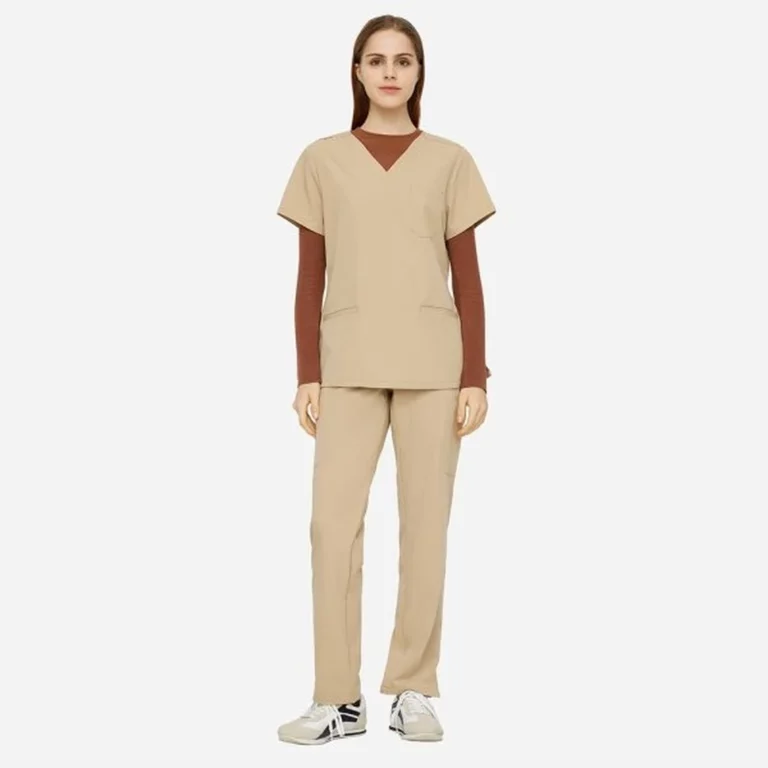
The pocket photo answers one question—where the pockets are—not whether they work on shift. A wearer should try the usual phone, pen and notes in the sample, then repeat the reach while standing, sitting and leaning forward. A phone that sits securely upright can move toward the opening during a bend. Compare that behaviour by size and after the order’s specified wash care.
Try the trouser pockets while seated as well as standing. A pocket bag can lie flat in the fitting room and bunch against the thigh once the wearer sits down. If a sample exposes that problem, note the posture and item involved. That gives the pattern team a concrete adjustment to assess before the uniform is graded or cut in volume.
Treat the fitting notes as part of sample approval. Record what went into each pocket, which size was worn, what movements were checked and whether the garment had been washed. Production staff can then repeat the same review instead of relying on a comment such as “pockets feel fine.”
What Should Each Pocket Actually Carry?
Pocket layout follows the wearer’s routine. A clinician may need one-handed access to a phone and pen; another role may carry compact tools. Ask a few intended wearers what stays in each pocket and when they reach for it. Their answers determine whether an item belongs on the top, trouser or elsewhere before pattern changes are approved.
Define contents and access together
A pen and a phone create different demands on the same pocket. Note the item’s approximate size and weight, then try the full combination if several objects will share one compartment. That reveals whether the opening is too narrow or the load makes the pocket pull away from the garment.
For a fitting, replace sharps or clinical tools with safe items of similar size and weight. This checks access and movement without creating a handling hazard. Keep the use boundary clear: a uniform pocket is not a sharps container or a medical protective device.
For a buyer developing a new layout, Fuyi Group’s CMO, OEM and ODM work can be a starting point for discussing the design brief. The company lists production bases in China and Myanmar. State whether the pocket arrangement is fixed or open for development, then review the proposed sample before treating it as the order reference.
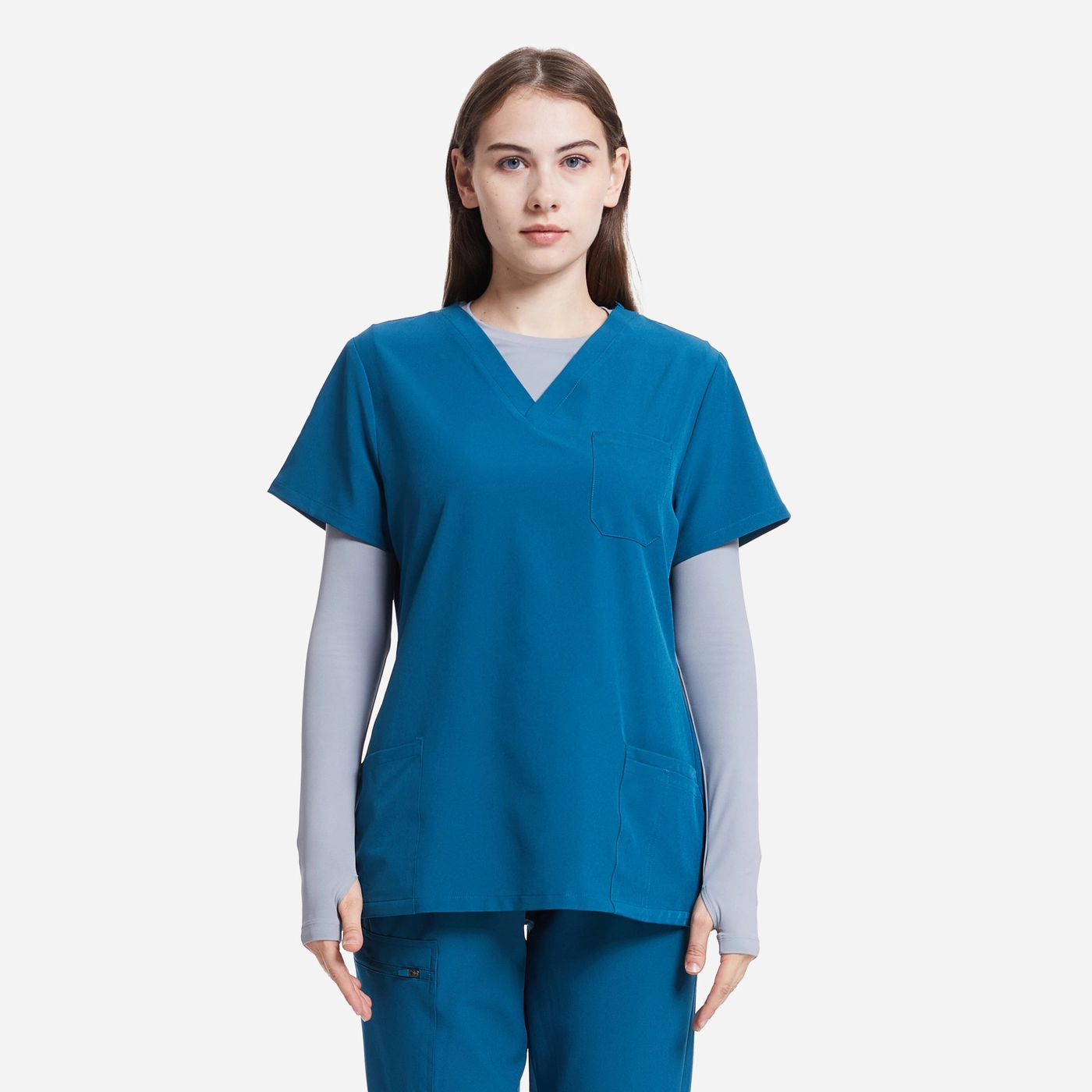
Compare usable space rather than outside dimensions
Take the garment off the table and put it on the wearer. A measurement from the outside can include space blocked by the seam allowance, flap or tapered bottom. Insert the actual phone or notebook, then check whether the hand can reach it without stretching the opening. The fit review answers a different question from the tape measure.
Review Fuyi Group medical scrub tops alongside your item list. Mark proposed changes on a photograph or drawing so the sample team knows which opening or pocket position you mean.
How Can You Test Scrub Pocket Design During Movement?
For the fitting, use the same contents and size wherever possible. The wearer can then compare revisions on something more meaningful than an empty garment: does the phone stay put during a bend, and can the pen be reached while seated? Record any movement that changes the answer.
Run a repeatable movement sequence
Use the same sequence for each sample: stand, sit, bend forward and reach. Watch the item as well as the pocket. If the opening spreads or the contents press into the wearer, ask them to retrieve the object without holding the garment in place. Record the movement that caused trouble; “hard to access” alone does not tell the pattern team what to change.
A phone that stays level during a standing check may tip toward the opening as soon as the wearer leans forward. Compare the pocket position, opening angle and any retention feature on the next sample. Adding stitches will not solve a reach or placement problem, so identify which part changed the result.
Fuyi Group Medical Uniforms lists polyester stretch and polyester-cotton fabrics. Note which fabric is used for the approved sample: a pocket’s drape may change with the cloth. Keep its fabric and pattern revision on the same approval record.
Include more than the middle size
Try a smaller and a larger size from the range. At one end, the pocket may sit too close to the side seam; at the other, it may be harder to reach. Check both on the wearer before using the middle size as the basis for approval.
Compare the approved top with the intended scrub trouser range. Moving storage between garments can be more effective than forcing every item into the top.
Which Construction Details Deserve a Closer Look?
Follow the load from the pocket opening through its attachment and reinforcement. Turn the sample inside out; the outer topstitch will not show whether the inside finish is even or whether the load is carried by the intended seam.
Examine the opening and load path
At the opening, check the upper corners and the full attachment seam. If the fabric puckers or the reinforcement misses the area being pulled, note the location on a photo. That gives the sample team a construction point to review instead of a broad request for stronger stitching.
Inspect the reinforcement inside the garment. Dense needle holes or puckering can weaken or distort the pocket. Judge the construction with the selected fabric and contents in mind, and agree the inspection method with the supplier.
Do not approve a pocket in one cloth and assume it transfers to another. Polyester stretch and polyester-cotton can hang and respond to a loaded phone differently. Record the chosen fabric beside the pattern revision so the bulk garment matches the sample reviewed.
Check both the face and the inside
Turn the top inside out and check the pocket bag and reinforcement. Then wear it with the lower pockets loaded. A neat exterior can hide a rough seam inside, and weight below can pull the hem even when the chest pocket passes.
Fuyi Group’s described checks cover incoming materials, in-process work and finished-product verification. For this order, ask QC to compare the approved fabric, opening, placement and inside reinforcement at the inspection stages specified in the purchase record.
What Should Be Written into the Bulk Approval?
Keep the sample that passed the fitting. Add a short card listing its size, contents, movement sequence and construction revision. That gives the next reviewer a physical garment to compare with the notes and lets production inspect the same arrangement the buyer accepted.
Repeat the checks after agreed care
After the agreed wash cycles, repeat the loaded fitting rather than judging the garment on appearance alone. Compare the opening, attachment seam and access to the contents with the retained sample. Note the care method and size, so a later revision can be checked on equal terms.
Fuyi Group lists OEM/ODM service, fabric and garment manufacturing, sample approval and production quality checks for its functional apparel work. Bring the approved pocket layout and the fabric choice into that discussion. Any load or durability requirement still needs an order-specific method and acceptance criteria.
Give inspectors something observable
Before the order is released, give the inspection team observable checks:
- Pocket opening, usable depth and placement tolerances for each relevant size.
- Intended contents and the movement sequence used for approval.
- Seam and reinforcement details, including photographs of the accepted inside finish.
- Care conditions, defect examples and the action required when a check fails.
Set a pass criterion around the actual brief. For one order, that may mean the phone stays inside during a bend; another may need an agreed seam check under a defined load. There is no number that applies to every scrub top. Record the method and result with the approved sample.
Use Fuyi Group‘s manufacturing capabilities to frame that discussion, then send your pocket development brief with the sample size range and intended contents.
Conclusion
Bulk approval should answer a practical question: can the intended items stay in the agreed pockets while the wearer moves, and does that remain true after the specified care? Name the accepted sample and document the checks. Without those references, “approved pocket design” can mean a different thing to the buyer and factory.
Build the layout around the items used during a shift, not the maximum number of pockets a sketch can hold. Fuyi Group’s fabric and garment development, OEM/ODM work and production checks give buyers a route to discuss the pattern and fabric together before a full run.
FAQs
Q1: Are more pockets always better for medical scrubs?
No. A higher count can mean more storage, but only if the pockets suit the wearer’s items and remain accessible through movement. Use the contents and tasks in the brief to decide which locations earn their place.
Q2: Should scrub pockets be tested after washing?
Yes. Follow the care conditions agreed for the order, then repeat the measurements and loaded movement review. That can reveal a change in access, shape or seam condition before bulk approval.
Q3: Can one sample size confirm the entire order?
Choose at least one smaller and one larger sample from the size run. Check reach and clearance in both; the middle size alone may hide a pocket that shifts too close to a seam or becomes difficult to access.