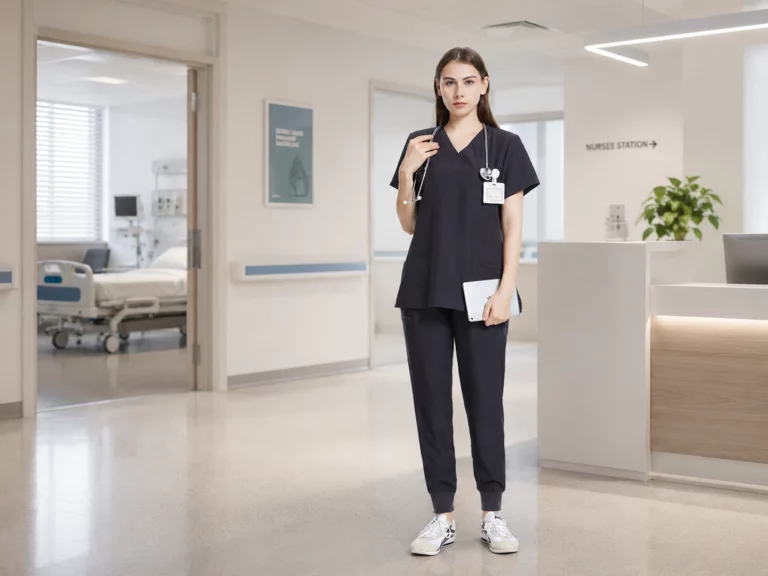
Hospitals get better results when they choose uniforms by department needs rather than forcing every employee into one garment specification. Movement, fluid exposure, laundering, staff identification, climate and daily tasks can all change what makes a uniform practical.
That does not mean every department needs a completely different uniform. A better approach is to build one hospital-wide system, then adjust the garment, fabric, fit or functional finish where the job actually demands it. This makes hospital uniforms easier to purchase, issue and reorder without ignoring the realities of different clinical roles.
For procurement teams, the key is to work in the right order: define the department, select the garment type, match the fabric, confirm the fit and color, test what matters, then lock the approved specification for bulk production.
Why Don’t All Departments Need the Same Hospital Uniforms?
A nurse moving between beds, a laboratory technician working at a bench and a doctor seeing patients may all wear medical uniforms, but their working conditions are not identical.
Start With the Job, Not the Style
General ward teams usually need freedom of movement, practical pockets and fabrics that remain comfortable through long periods of wear. ICU staff may place more emphasis on resistance to incidental liquid splashes. Maternity and postpartum environments can put greater emphasis on soft, skin-friendly fabrics.
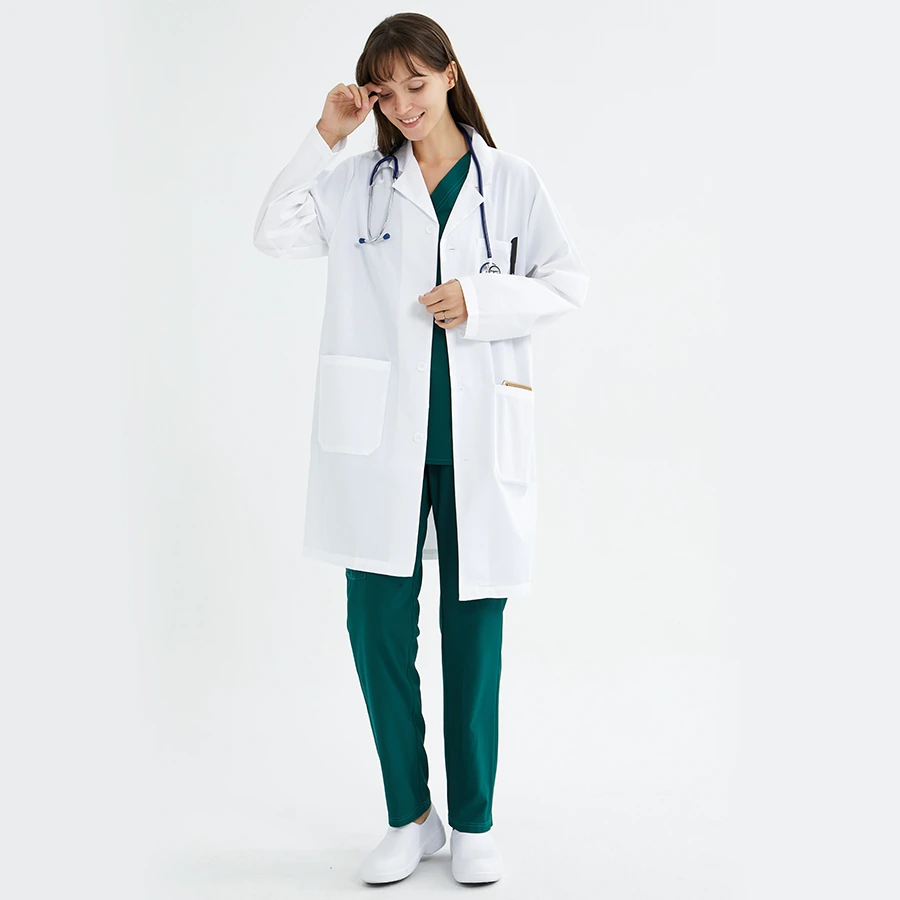
Lab coats solve a different problem. They provide another layer over the working uniform and make sense for laboratory, consultation and other roles where that format fits the hospital’s own policy.
This is why hospital staff uniforms work better as a coordinated system rather than a single specification copied across every department.
Buyers planning several departments can first compare the available medical scrub collection and decide which garment categories actually belong in the program.
Keep Department Identity Without Creating Procurement Chaos
Color is often used to distinguish teams, but there is no universal color rule that every hospital follows. One organization might place nurses in navy and another might use ceil blue or a completely different system.
The practical task is not to find the “correct” global color. It is to establish an internal color matrix, approve the shades, and make sure future orders follow the same standard.
Fit needs similar control. Women’s, men’s and unisex options can sit inside one uniform program without turning every reorder into a new project.
Which Hospital Uniforms Fit Different Roles?
The garment itself is the next decision. Scrub sets may cover most clinical staff, but they do not have to cover every role.
Scrub Sets Work Well for Active Clinical Teams
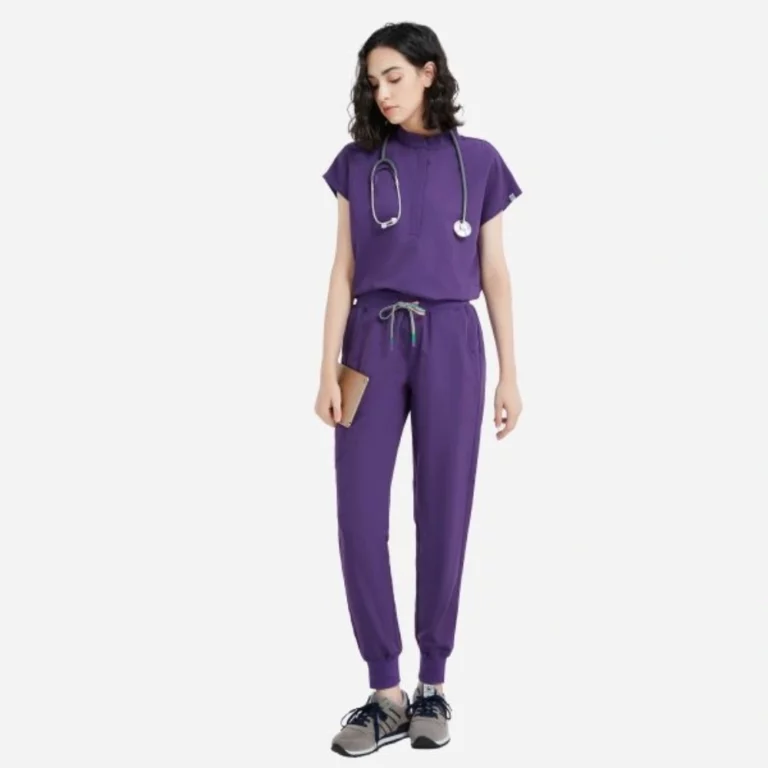
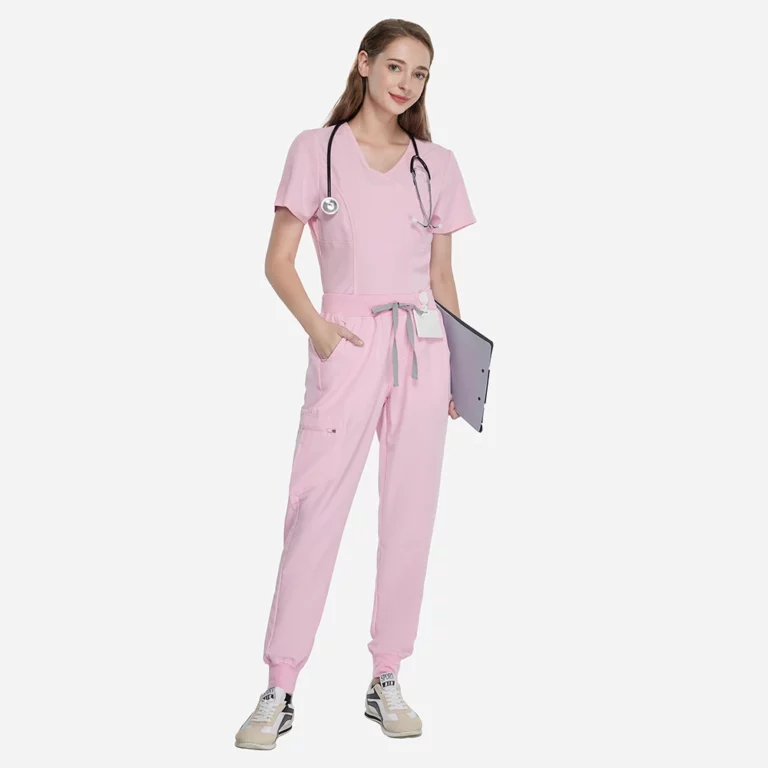
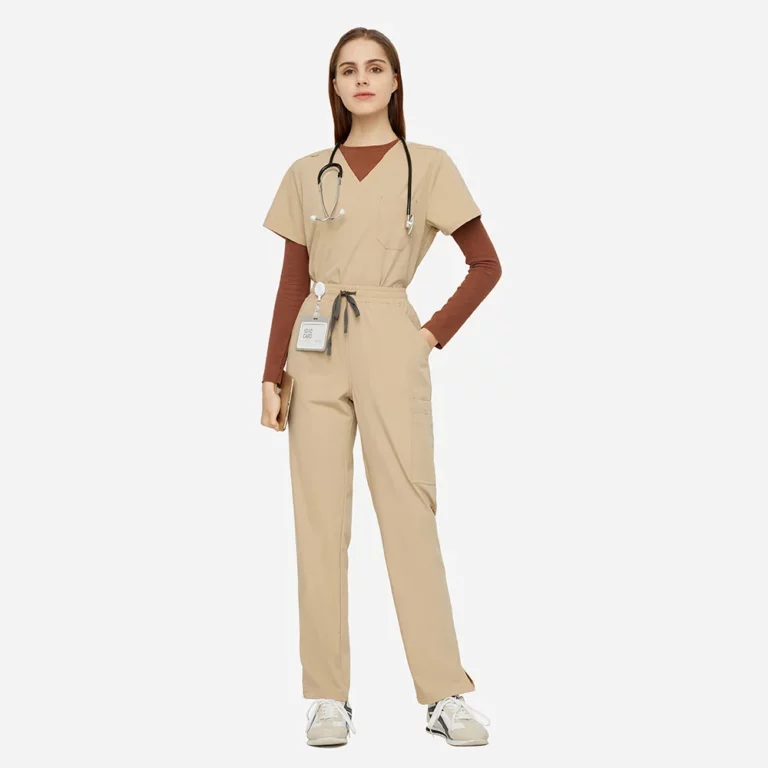
Scrub tops and pants remain practical for departments where employees walk, bend, reach and carry items throughout the shift. Buyers can choose between jogger and straight-leg pants, different pocket layouts and different top shapes without changing the whole uniform system.
For example, Fuyi’s 72% polyester, 21% rayon and 7% spandex medical fabric is used across multiple scrub styles. At 200 GSM, it combines four-way stretch, softness, breathability and wrinkle resistance. That gives buyers room to vary the style while keeping a common fabric platform.
This can be useful when medical uniforms for hospitals need a recognizable look but different teams prefer different pocket layouts or pant silhouettes.
Where Do Lab Coats and Layers Fit?
Lab coats are better treated as part of the overall hospital wardrobe rather than an alternative to every scrub set. Doctors, laboratories and selected technical roles may need them while other departments do not.
Fuyi also supports lab coat options, allowing procurement teams to cover scrubs and additional clinical garments within the same sourcing project.
Layering pieces can also matter in air-conditioned areas, cooler seasons or roles that move between different indoor conditions. The goal is not to add garments for the sake of variety. Each item needs a clear role in the uniform plan.
How Should Fabric Change Between Departments?
Fabric selection becomes easier once the job has been defined. Instead of asking which scrub fabric is best, buyers can ask which characteristics matter for each group.
Does the Department Need More Stretch and Softness?
For employees who bend, lift or move frequently, stretch can have a direct effect on daily comfort.
Fuyi’s Poly Rayon 4 Way Stretch fabric uses 72% polyester, 21% rayon and 7% spandex at 200 GSM. It is designed around four-way stretch, a soft hand feel, breathability and wrinkle resistance. A water-repellent treatment can also be applied where the order requires it.
Buyers comparing this type of fabric can view the Poly Rayon 4 Way Stretch Series and then decide whether those characteristics match the department rather than assuming a heavier or more elastic fabric is automatically better.
When Does a Lighter Fabric Make More Sense?
A second option is the 94% polyester and 6% spandex Poly Stretch fabric at 170 GSM. It offers stretch, breathability, easy care and recovery from light wrinkling, while its surface can also receive a water-repellent treatment.
A lighter construction may suit a different climate, budget or staff preference than a 200 GSM poly-rayon blend. Neither specification replaces the need for testing.
This is where hospital uniform procurement becomes more disciplined. Instead of choosing fabric by feel alone, buyers can compare composition, GSM, stretch, wash requirements, colorfastness and any required functional treatment.
What Must Hospital Uniform Procurement Check Before Approval?
A good sample can still create problems later if the approved specification is vague. Bulk medical uniforms need measurable checkpoints before production starts.
Lock the Fabric and Performance Requirements
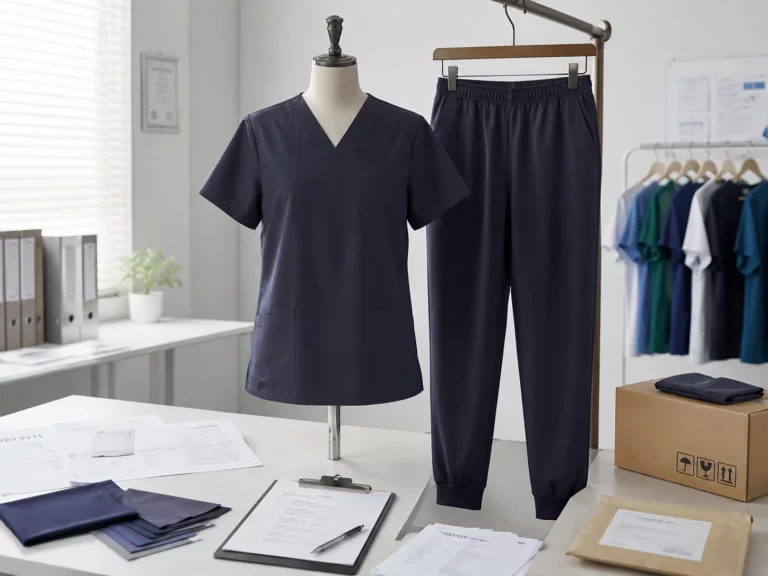
A useful approval sheet can include:
- fabric composition and GSM
- approved color or color reference
- garment measurements and size range
- shrinkage requirements
- colorfastness requirements
- pocket and trim details
- embroidery or logo position
- wash and care requirements
- water repellency or antibacterial performance when required
Not every hospital needs every function. A postpartum care project may place more attention on skin friendliness, while an ICU order may ask for water-repellent performance. The specification needs to follow the actual use case.
Fuyi can support medical projects with fabric composition, physical-performance and functional testing. Depending on the program, this can include colorfastness, shrinkage, water repellency and antibacterial testing.
Test Before the Bulk Order Becomes Expensive to Change
Small-sample testing is much cheaper than discovering a mismatch after thousands of garments have been cut.
Fabric, color, fit and functional requirements can be checked before mass production. For projects that involve special medical requirements, the relevant testing should also be agreed before the bulk order is released.
Think of a hospital adding uniforms for an ICU and a postpartum care unit at the same time. Using the same color system may be simple, but copying the same functional specification into both departments may not be. The ICU may prioritize splash resistance, while the postpartum team may place more weight on softness and skin contact. One purchasing project can still handle both if those differences are defined early.
How Can Bulk Medical Uniforms Stay Consistent on Reorders?
The first delivery is only part of the job. Hospitals often need replacement sizes, new-staff uniforms and scheduled replenishment long after the initial order.
Treat the Approved Sample as the Reference
Once the hospital has accepted the fabric, color, dimensions and workmanship, those details need to remain tied to the reorder.
Color control is especially important. A top ordered today should not look unrelated to matching pants purchased in a later batch. Fabric consistency, stable dyeing and retained specifications reduce that risk.
Fuyi controls its supply chain from fabric development and production through garment manufacturing. The company has around 60 years of fabric-production experience, with a fabric factory capable of producing about 3 million meters of uniform fabric per month. Its garment operations have an annual capacity of about 5 million pieces.
That fabric-to-garment structure gives buyers a single manufacturing system for fabric development, garment production and quality control rather than separating those stages across unrelated suppliers.
Plan Reorders Before the First Order Ships
Hospitals can also reduce future work by recording:
- approved fabric code
- approved colors
- top and pant styles
- size breakdown
- logo files and positions
- packing requirements
- testing requirements
- approved sample reference
This turns the next order into a controlled repeat order instead of another development project.
What Makes a Medical Uniform Supplier Easier to Work With Long Term?
Price matters, but a low unit price does not solve mismatched colors, unclear testing or unreliable replenishment.
Look Beyond the Garment Sample
A hospital uniform supplier needs to manage more than sewing. Buyers may need fabric development, sampling, test coordination, production tracking, inspection and logistics support.
Fuyi integrates fabric R&D and production with garment design and manufacturing. Its garment operations include three factories in Myanmar with around 2,500 employees, while its products are supplied to customers in about 80 countries.
For buyers handling hospital staff uniforms across several departments, that structure allows one sourcing project to cover different scrub styles, fabrics and related medical garments.
The wider Fuyi Group medical uniform range also gives procurement teams room to build a program around sets, tops, pants, lab coats, jackets and different fit options rather than sourcing each item independently.
Make the Supplier Prove the Specification
The supplier still needs to work from the hospital’s approved requirements. Fabric composition, function, color, workmanship and delivery expectations should be confirmed rather than assumed.
For customized orders, Fuyi supports OEM and ODM work and can coordinate fabric selection, garment development, testing and production management. Production progress can also be tracked through cutting, sewing and inspection stages.
If you already have department lists, fabric requirements or an existing hospital specification, send your hospital uniform requirements so the project can be reviewed against available fabrics, garment types and testing needs before bulk production.
Conclusion: How Do You Build a Uniform System That Lasts?
The most practical hospital uniform system is not one garment forced onto every employee. It is one controlled framework with enough flexibility for different departments.
Start with what each team actually does. Then decide which garments, fabric weights, stretch levels, fits, colors and functional requirements support that work. Confirm those choices through samples and relevant testing, and keep the final specification for future replenishment.
This approach helps medical uniforms for hospitals stay easier to manage as staff numbers, departments and reorder volumes change. It also gives procurement teams a clearer basis for comparing suppliers than price alone. With fabric production, garment manufacturing, OEM/ODM development and medical uniform options under one supply chain, Fuyi can support both the first bulk order and the repeat orders that follow.
FAQs
Q1. Can one scrub fabric work for every hospital department?
A1. It can work across several departments if the performance matches their needs, but it should not be assumed automatically. A general ward may prioritize comfort and easy care, while an ICU may need additional water-repellent performance and another department may place more emphasis on skin friendliness. The fabric specification should follow the working environment.
Q2. Do hospitals use the same scrub colors for each department?
A2. No universal hospital color system applies everywhere. Each hospital can create its own color matrix for nurses, doctors, technicians or other staff. Once the colors are approved, the important purchasing task is keeping those shades consistent across bulk orders and later replenishment.
Q3. What should buyers test before ordering hospital uniforms in bulk?
A3. Buyers can start with composition, GSM, measurements, shrinkage, colorfastness and wash performance. Stretch, water repellency, antibacterial performance or other functional tests can be added when the department or tender requires them. Samples should be approved before bulk production so the final order has a clear reference.