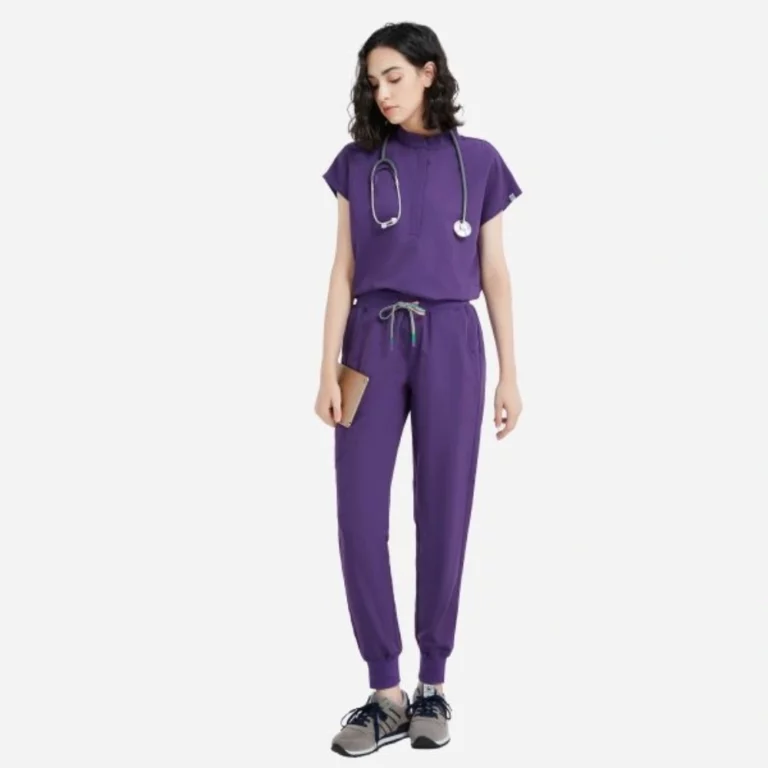
Dark grey scrubs sit in a useful middle ground for many clinical teams: less stark than black, more grounded than light grey, and easy to coordinate with common footwear, jackets, or underscrubs. That visual flexibility does not make every grey garment a practical choice. The color name can vary, the fabric can change how the garment moves and launders, and women’s and men’s sizing may behave differently even when both styles appear to use the same shade.
A controlled choice starts with a physical color reference and a clear clinical use case. From there, the buyer can compare fabric construction, fit, care requirements, and repeat-order controls without treating “dark grey scrubs” as a single product promise. The goal is not simply to choose grey; it is to choose a grey scrub specification that can be sampled, approved, reproduced, and worn through a real work cycle.
What should you check before choosing dark grey scrubs?
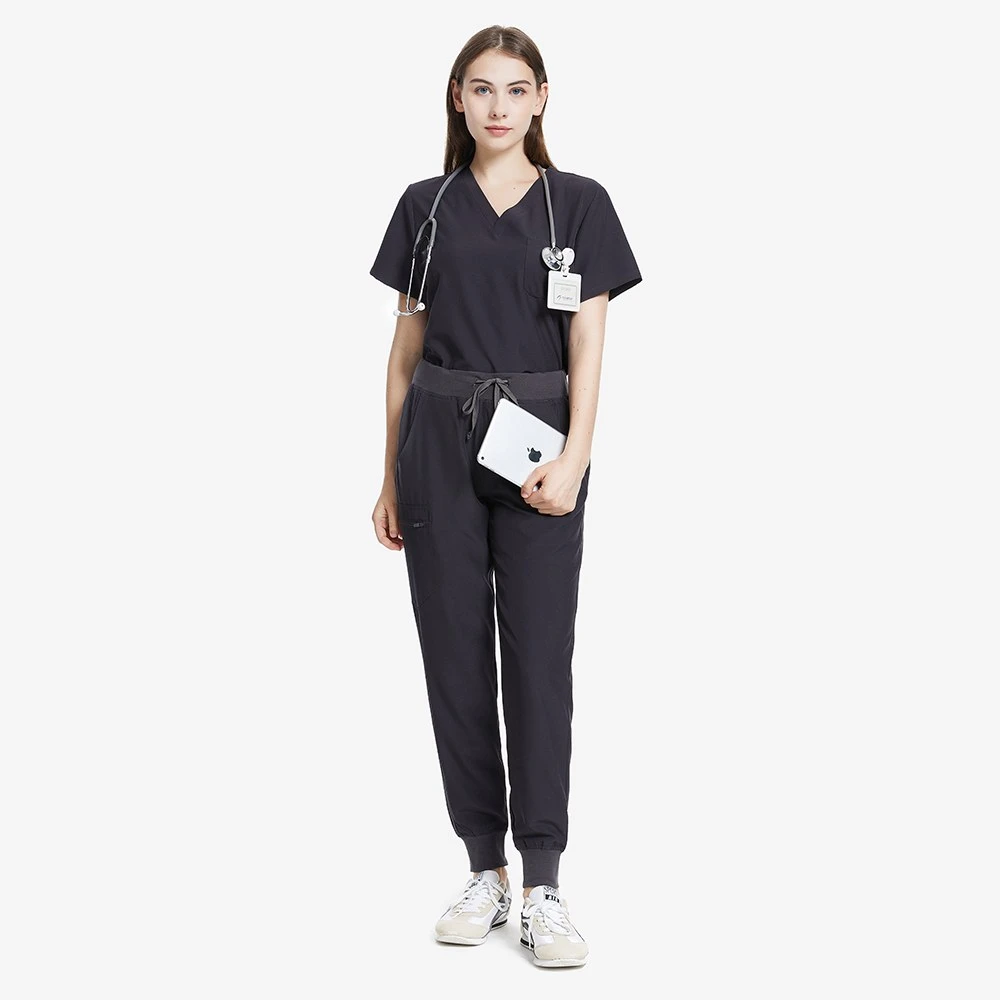
The first decision is not which grey looks best online. It is what the color must do in the intended setting and how the team will verify that the shade is correct. Product collections often combine grey, charcoal grey, and pewter under labels that appear interchangeable. In practice, those names can describe different positions on the color scale, and suppliers may use them differently. A buyer should therefore treat the name as a starting point, not as a shared standard. A reference swatch or approved sample is more reliable than a screen image. Color guidance for healthcare uniforms, such as the why one scrub color becomes a clinical staple, also shows why a color decision should be connected to the team rather than treated as an isolated style preference.
How do grey, charcoal grey, and pewter names differ?
Grey scrub options usually describe a broad neutral family. Charcoal grey scrubs generally sit at the darker end of that family, while pewter is often used for a softer or more metallic-looking middle grey. Those descriptions are not universal, so the safest process is to compare the reference under controlled light before comparing price. The Valiant dark grey scrub set provides one official product reference for checking how that darker grey specification is presented. Ask for the color reference in the intended fabric, because the same dye recipe can look different on a lightweight poly stretch material and on a heavier poly rayon blend. If a supplier cannot show the color and fabric together, the buyer is approving an idea rather than a production specification.
The same logic applies when comparing women’s grey scrubs with men’s grey scrubs. Both may be listed under one grey heading while using different pattern blocks, size ranges, or seam placement. The color reference should remain consistent, but the fit specification should be evaluated separately. That prevents a team from approving one garment sample and assuming every size or gender option has the same behavior.
Does the clinical setting change the color decision?
Department color rules vary. Some organizations use color to distinguish roles, while others allow personal preference within a broad dress code. A dark grey option may fit a clinical setting where black feels too severe and light grey shows wear too quickly, but no color should be selected on that assumption alone. The practical check is whether the team, department, or purchasing policy accepts the shade and whether the garment will remain recognizable under the lighting and working conditions where it is worn.
Grey also needs to work as part of a system. A top may be paired with scrub pants in the same color, a contrasting jacket, or a different grey for a department distinction. Buyers should confirm the exact pieces, reference numbers, and acceptable color variation before sampling. This is where charcoal grey scrubs can become complicated: one department may use charcoal as a near-black neutral, while another expects a visibly lighter grey. The approved reference and product scope matter more than the label.
Which fabric and fit details support clinical work?
Color identifies the garment, but fabric and fit determine whether it supports movement, comfort, and a repeatable appearance. The evaluation should include weight, stretch and recovery, drape, breathability, wrinkle behavior, care requirements, and the fit across the expected size range. This part of the decision benefits from reviewing stretch, breathability, and care checks for medical scrub fabrics.
How do 170 GSM and 200 GSM scrub fabrics differ?
Fuyi Group offers two medical scrub fabric options that illustrate the trade-offs. The 170 GSM poly stretch scrub fabric is 94% polyester and 6% spandex. This fabric family is described with moderate stretch, good drape, breathability, easy recovery from slight wrinkles, easy daily cleaning, and high dye fastness. It can suit buyers who want a lighter-feeling option with a straightforward care routine.
A separate 200 GSM poly rayon fabric is 72% polyester, 21% rayon, and 7% spandex with four-way stretch. That fabric family is described as soft, breathable, anti-wrinkle, skin-friendly, and stable in physical properties. The higher weight and rayon content may appeal to teams looking for a softer, fuller hand and more stretch. Neither option should be treated as universally better. The right choice depends on the wearer, the intended movement, the laundering process, and the color reference being sampled.
Before final approval, compare the fabrics with the actual garment construction. A fabric that feels suitable as a swatch may drape differently in a scrub top, behave differently in a jogger, or interact differently with embroidery and pocket reinforcement. Those details belong in the sample review rather than being decided from GSM alone.
What should women’s and men’s grey scrubs prove before approval?
Women’s grey scrubs and men’s grey scrubs should be tested for the movements that matter during a shift: sitting, reaching, bending, walking, and carrying items in pockets. The sample should show whether the waistband stays in place, whether the rise and leg length suit the wearer, whether the neckline remains comfortable, and whether the pockets are usable without pulling the garment out of shape.
Fit guidance for men’s scrubs in healthcare work can support the men’s evaluation, while the comparison of men’s and unisex scrub sizing helps when a program wants one unisex block instead of separate patterns. Whichever route is chosen, approval should include the largest and smallest expected sizes. A medium sample cannot prove that the same design will feel or move correctly across the full range.
How should you protect color and appearance in use?
Once a grey scrub is selected, appearance depends on more than the original swatch. Washing, drying, stain exposure, repeated use, and replenishment all affect whether the garments continue to look like the same uniform program. The buyer should define how the color and material will be checked after representative care cycles, not wait until the first bulk shipment is in service.
Which laundering and colorfastness checks belong in the order?
The care requirement should be written before production. For a grey scrub order, confirm the wash temperature, detergent assumptions, drying method, ironing expectations, and the colorfastness or appearance checks required by the organization. Dyeing controls at Fuyi Group use consistent dye and chemical formulas, raw materials, and dyeing equipment to support colorfastness and reduce batch variation. Those controls are relevant to the product and order scope; the required test method and acceptance level still need to be agreed for the selected fabric, color, and customer requirement.
A practical order specification can ask for a wash-and-care sample, a color reference retained with the approved sample, and a clear procedure for checking future lots. If the scrubs will be industrially laundered, say so before sampling. If they will be washed at home, confirm that the care instructions match the intended routine. The point is to test the conditions the garment will actually face.
How can repeat orders keep grey colors consistent?
Repeat orders need a color and material reference, not a repeated color name. Keep the approved fabric, composition and weight, color reference, measurements, logo details, trims, labels, packing, and inspection criteria together. When the next order begins, compare the proposed materials and color reference with that record before production.
Dyeing controls are designed to reduce batch variation within the process, but that does not remove the need for order-specific confirmation. Ask how the supplier will retain the color standard, how a new fabric lot will be evaluated, and what happens if the new production falls outside the approved range. A clear repeat-order process protects the clinical program from subtle color drift that may only become visible when old and new garments are worn together.
What should be confirmed before a bulk grey scrub order?
Bulk ordering turns an acceptable sample into a production commitment. The buyer should confirm that the sample, measurement specification, fabric, color, branding, packaging, and inspection plan describe one product. This control step is especially important for dark grey and charcoal grey because a small color shift can become visible across departments, sizes, or repeat shipments.
What belongs in the sample approval record?
The approval record should identify the garment style and size set, the exact fabric family, color reference, approved measurements, construction details, pocket layout, branding placement, labels, and packaging. It should also state which sample version is authoritative if the supplier sends more than one round of revisions. Photographs can help, but they should support the physical reference rather than replace it.
The quality process can then be tied to the order. The quality process at Fuyi Group includes pre-production review, incoming material inspection, in-production inspection, finished-product inspection, and QC/QA monitoring. The exact inspection plan and acceptance criteria still need to match the selected grey scrub order. Recording those points prevents the phrase “same as sample” from carrying assumptions that were never written down.
What information should the final quote request include?
The final quote request should give the supplier one comparable specification: target market, clinical setting, garment category, primary dark grey color reference, acceptable alternative grey name, fabric and weight, stretch and care requirements, size range, pocket and fit details, branding, testing, packaging, planned quantity, delivery window, and repeat-order expectations. It should also state how color and measurement checks will be approved.
A complete request helps the buyer compare quotes without mixing different fabrics, color assumptions, or service scopes. It also gives the supplier a clear basis for sampling. If the article’s broader design direction is still open, the medical scrub design trends healthcare teams are choosing can help frame that discussion, but the final purchase specification should stay specific to the approved garment.
Conclusion
Dark grey scrub garments are practical when the color, fabric, fit, care, and order controls all support the same clinical decision. Approve a physical grey reference, choose the fabric by weight and behavior rather than by name alone, test women’s and men’s sizing across the expected range, and write the laundering and repeat-order checks into the specification. A controlled sample then becomes the reference for production instead of a loose visual preference. To move forward, share the intended clinical setting, grey color reference, fabric and performance needs, size range, branding scope, testing criteria, order quantity, delivery window, and repeat-order plan with the Fuyi Group team so the next step can be quoted and sampled against one clear brief.
FAQs
Q1: Are dark grey scrubs suitable for every department?
A1: No. Departmental color rules vary. Confirm the organization’s dress code, how the color will be used, and whether the shade needs to distinguish a role before approving the color for a team.
Q2: Is charcoal grey the same as dark grey?
A2: Not necessarily. The charcoal end usually sits at the darker end of the grey family, but suppliers do not use color names identically. Compare a physical fabric swatch and retain it as the approved reference.
Q3: What should be confirmed before ordering grey scrub garments in bulk?
A3: Confirm the exact grey reference, fabric and weight, size range, fit sample, branding, testing and laundering requirements, packing, order quantity, delivery window, and repeat-order controls. Keep those details with the approved sample so every production lot is measured against the same specification.